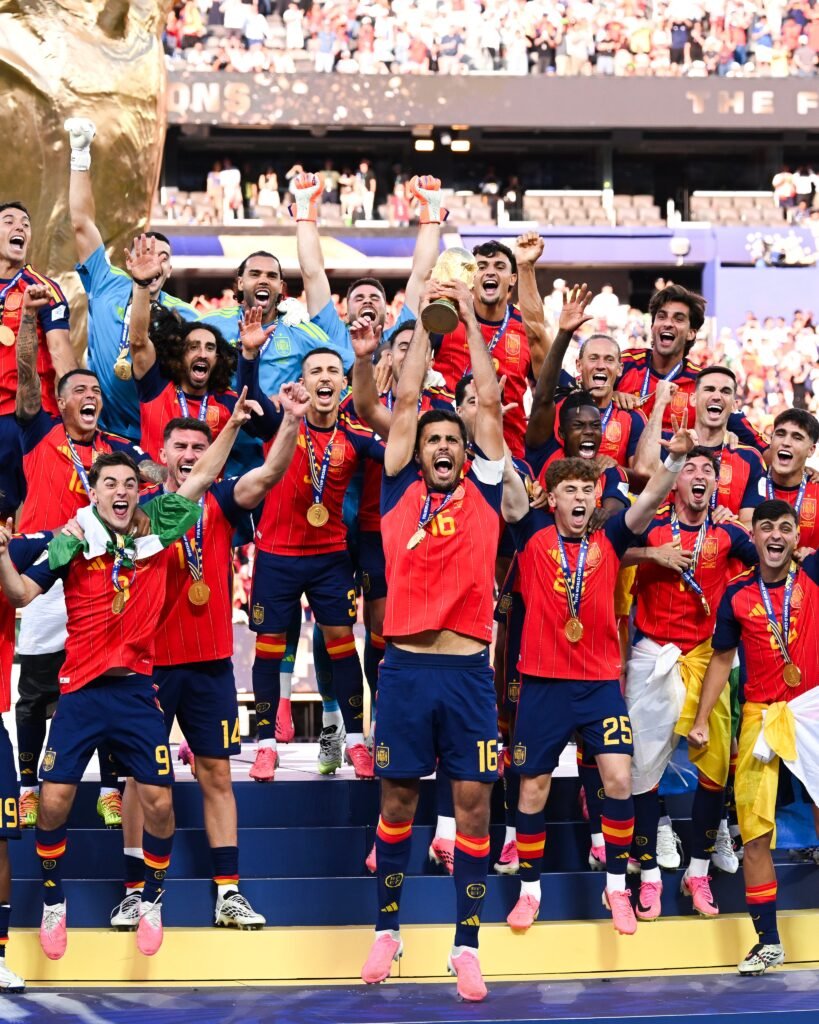
Spain won the FIFA World Cup 2026 final 1-0 after extra time against defending champions Argentina at New York New Jersey Stadium, East Rutherford, on Sunday, July 19. Ferran Torres scored the only goal of the contest in the 106th minute, converting Spain’s 20th shot of the match, to secure the nation’s second World Cup title and deny Argentina the chance to become just the third team in history to retain the trophy.
There is a particular cruelty reserved for teams that dominate the ball but not the moment, and Argentina lived that cruelty for three hours in New Jersey. They had come to defend an empire, chasing a piece of history that only Brazil and Italy had ever claimed. They left with nothing, undone not by a flood of Spanish pressure but by a single, precise finish deep into a contest that had threatened to deny both teams their chance at immortality.
For Spain, this was a return to a feeling they had not allowed themselves to expect. Sixteen years after Andrés Iniesta’s extra-time winner delivered their first World Cup in South Africa, another Spanish hero found the same late, decisive moment. The parallel will not be lost on a nation that has waited a generation to feel it again.
A final that refused to break early
The opening exchanges gave little indication of the tension that would define the closing act. Both sides arrived as the two best-ranked teams in the world, the first time FIFA’s No. 1 and No. 2 had ever met in a World Cup final since rankings began in 1992, and the occasion carried the caution that such billing demands. Neither team wanted to be the first to blink, and for long stretches, neither did.
Argentina’s approach leaned on control rather than penetration. Lionel Messi, playing in what may prove his final World Cup appearance, touched the ball just 54 times across the match, a modest tally that spoke to how thoroughly Spain had planned to smother his influence. It worked. Argentina did not manage a single shot on target in 120 minutes of football, a statistic almost unthinkable for a team that had arrived as champions and left as challengers.
The weight of chances not taken
Spain, by contrast, kept probing. Their approach was patient rather than urgent, built on the conviction that a breakthrough would eventually arrive if they kept asking the question. It took until Torres’ goal for that question to be answered, but the volume of attempts told its own story: Torres’ winner arrived from Spain’s 20th shot of the afternoon, a number that reflected persistence more than fluency.
Extra time is where finals are decided by nerve as much as quality, and it was here that Spain’s patience paid its dividend. Torres found the moment that had eluded his teammates for over 100 minutes. His finish in the 106th minute proved to be the only act of true precision in a game defined largely by containment.
A trophy that rewrites the recent order
The win completes a full-circle moment for Spanish football. Their only previous world title arrived in 2010 through Iniesta’s extra-time strike, and now Torres has etched his name alongside that memory as Spain’s second World Cup triumph. For Argentina, the defeat ends their bid to join Brazil (1958, 1962) and Italy (1934, 1938) as the only nations to retain the trophy, a piece of history that will now have to wait for another generation.
The individual honours added further context to the story of the tournament. Rodri, Spain’s captain, was named winner of the Golden Ball as the competition’s outstanding player, while his goalkeeper Unai Simón collected the Golden Glove. Messi, despite his quiet final, finished the tournament as runner-up in the scoring charts, two goals shy of Kylian Mbappé, who claimed the Golden Boot. Spain’s younger generation, including Lamine Yamal and Nico Williams, now inherit a World Cup title as their platform heading into the next cycle of international football.
Looking ahead
Spain’s celebrations in New Jersey mark not an ending but a beginning for a squad blending experienced winners with emerging talent still to reach their peak. Argentina, for their part, must now begin the process of transition, aware that the window built around Messi’s later years has likely closed on the sport’s biggest stage. Both nations will carry the lessons of this final into World Cup qualifying and future tournaments, but for now, it is Spain’s name being added to the trophy, and Torres’ strike that will be replayed whenever this final is remembered.