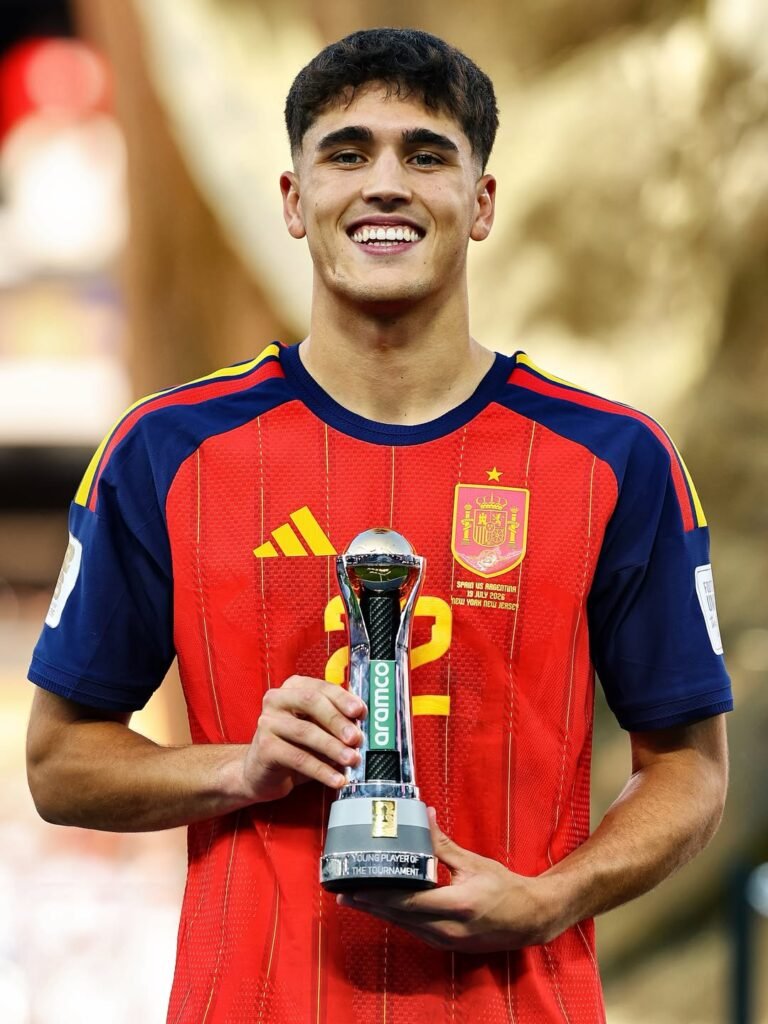
Spain won the 2026 FIFA World Cup, beating Argentina in a final that went to 120 minutes at New York New Jersey Stadium in East Rutherford, New Jersey. Nineteen-year-old defender Pau Cubarsi, who started and played every minute of Spain’s championship run, was named the tournament’s Young Player Award after helping restrict opponents to a single goal conceded across the entire campaign, including just one shot from Argentina over the full final. Spain’s triumph marks their second World Cup title, with Unai Simon claiming the Golden Glove for five clean sheets.
There is a particular kind of composure that cannot be taught, only revealed under the weight of a World Cup final. For Pau Cubarsi, that revelation arrived not as a single moment of brilliance but as a sustained, tournament-long refusal to be moved. By the time Spain’s name was etched into the trophy for a second time, the teenager had played every single minute of the run, a statistic that speaks less to endurance and more to trust — the trust of a coaching staff who never once felt the need to look elsewhere.
This was not a story of individual heroics in the conventional sense. It was a story of a defence so complete, so quietly dominant, that a 19-year-old could walk out of the world’s biggest stage as its outstanding young performer without needing a single goal to his name.
A campaign built on denial, not spectacle
Spain’s route to the final was defined by what did not happen. Across eight matches, a single goal breached their defence — a remarkable seal for any World Cup campaign, let alone one that ended in a final stretching to 120 minutes against an Argentina side containing Lionel Messi. Cubarsi sat at the heart of that resistance, and his presence in every one of those minutes tells its own story: this was not a squad rotation exercise, but a management decision built on unwavering conviction.
The final itself became the tournament’s defining testament. Argentina, for all their attacking pedigree, were held to just one shot across two hours of football. That is not a statistic that happens by accident. It is the product of a defensive unit reading angles, closing space and refusing to panic when the contest extended beyond regulation time.
The quiet architecture behind the headlines
While Cubarsi’s award recognised individual excellence, the final was won collectively, and the underlying numbers reveal how thoroughly Spain controlled proceedings. Rodri’s afternoon encapsulated that control: 101 of 106 passes completed, never once dispossessed across 99 minutes of regulation and extra time, and third among all players for ball touches behind only Cubarsi and Pedro Porro. He added eight ground duels won from ten, two chances created, and three fouls drawn — the profile of a midfielder dictating tempo rather than chasing the game.
That Rodri’s touch count trailed only Cubarsi and Pedro Porro speaks to how Spain approached the final: not as a shootout to be won in flashes, but as a territory battle to be controlled minute by minute. Cubarsi’s involvement at the top of that chart, ahead of a player of Rodri’s stature, underlines how central the teenager had become to everything Spain tried to do, in possession and out of it.
A defender’s award in a forward’s game
His award was earned not through goals but through denial — the single goal conceded across an entire World Cup, the one shot allowed in a 120-minute final, the presence in every minute of a triumphant campaign.
His path to this point was never accidental. A graduate of Barcelona’s La Masia academy, Cubarsi has already amassed 128 senior appearances for Barcelona and helped the club to back-to-back La Liga titles, all before his 20th birthday. Add an Olympic gold with Spain’s under-23s in 2024 and 20 senior caps, and the World Cup final in East Rutherford reads less like a breakthrough and more like a culmination — the latest, largest stage on which a defender already trusted at club level proved he belonged at international football’s summit too.
What comes next
Spain’s second World Cup title, sealed alongside individual honours for Cubarsi and Simon, sets a new benchmark for a defence that conceded almost nothing across an entire tournament. For Cubarsi, still only 19, the more pressing question now shifts to sustainability — whether a teenager who played every minute of a World Cup-winning campaign can carry that level of responsibility into the club season and beyond, with Barcelona and Spain both likely to lean on him as a cornerstone for years to come. The individual awards will fade from headlines, but the standard set in New Jersey — a single goal conceded across eight matches, a single shot allowed in a final — will linger as the measure by which future title defences are judged.