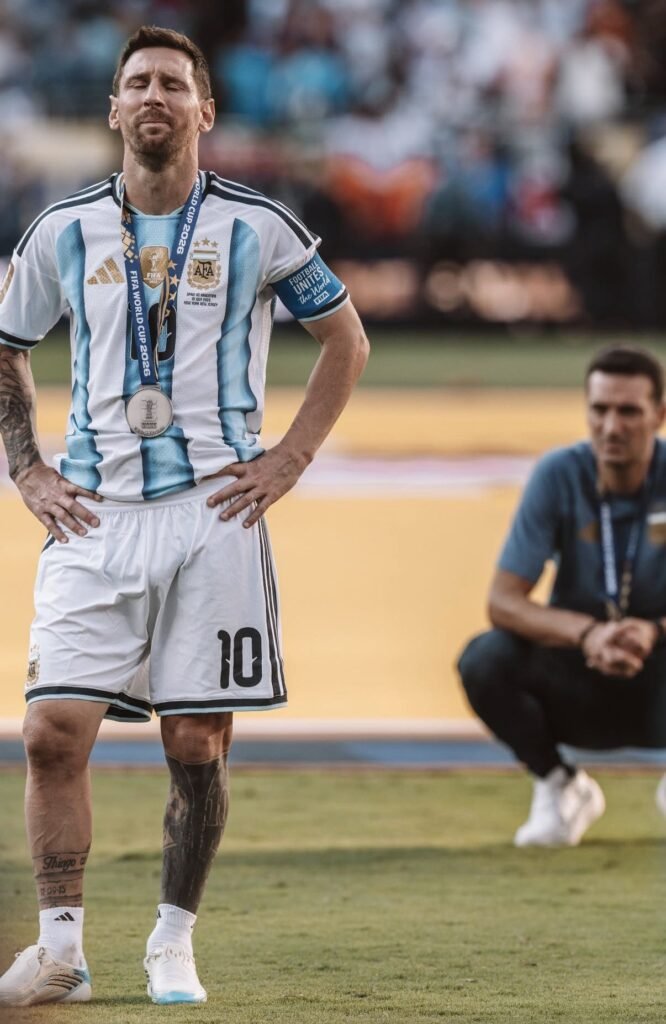
Argentina lost the 2026 FIFA World Cup Final 1-0 to Spain, denying Lionel Messi a second consecutive title and a storybook finish to his sixth World Cup appearance. The defeat means Messi joins Brazil’s Cafu as only the second player to start in three World Cup Finals, while Spain claimed their second-ever World Cup title, adding to their 2010 triumph and consolidating a period of dominance that began with victory at Euro 2024.
There is a version of this story that ends with Lionel Messi lifting the World Cup for a second time, closing the loop on a career that has already given football almost everything it can offer. That is not the version that played out. Instead, Argentina’s captain walked off a World Cup pitch for what may be the final time in defeat, 1-0 to a Spain side too composed, too relentless, to be denied.
It is a familiar shape for Messi’s World Cup story — heartbreak followed by triumph followed, now, by heartbreak again. But the numbers he leaves behind, and the company he now keeps, tell a different tale altogether: one of a player who redefined what longevity and brilliance could look like on football’s biggest stage.
A third final, a rarefied club
Messi’s appearance in the 2026 final means he has now started three FIFA World Cup Finals, in 2014, 2022 and 2026. Only Cafu, the Brazilian full-back, has managed the feat before him. It is a statistic that speaks less to fortune and more to a two-decade span in which Messi has, more often than not, been the difference between his country reaching the final weekend and going home early.
That Argentina reached the final in three of the last four World Cups underlines the point. Between the heartbreak of 2014, the triumph of 2022, and this latest defeat in 2026, Messi has dragged a talented but not always dominant Argentina side to the very last match of the tournament with a consistency matched by almost no one in the sport’s history.
The tournament that refused to fade quietly
Whatever regret Messi carries from the final itself, his sixth World Cup was not a farewell lap. He became the oldest player to score a hat-trick at a World Cup, doing so against Algeria at 39 years of age, and produced an assist against Egypt that made him the first player ever to register an assist in six different World Cups. Few players have ever authored a career postscript this emphatic.
He arrived at the final sitting second in the Golden Boot race, with 8 goals and 4 assists from 712 minutes, trailing only Kylian Mbappé’s 10 goals and 4 assists from 769 minutes. It was the duel between Messi and Mbappé — the two players who have now scored seven goals in multiple World Cups — that once again defined the tournament’s attacking narrative.
The underlying numbers reinforce how central Messi remained even in his late thirties. He completed 25 dribbles, the most of any player at the tournament, and added 48 take-ons, second only to Lamine Yamal on 52. It was proof, if any were still needed, that age had blunted none of his capacity to unbalance a defence.
A career measured in decades, not tournaments
Across six World Cups stretching from 2006 to 2026, Messi leaves with 21 goals and 12 assists, combined totals that place him among the most productive players the tournament has ever seen. He has now scored against 15 different opponents at World Cups, the most in the competition’s history, and has played 33 matches and won 23 of them — both records.
Perhaps most remarkable is the run he carried into this final: Messi had scored or assisted in 11 straight World Cup matches, the longest such streak since 1966. It is a statistic that captures the essence of his tournament career — not a single dazzling moment, but a sustained, almost unbroken pattern of influence stretching back years.
None of it, in the end, was enough to beat a Spain side playing with the certainty of champions. Their victory made it back-to-back major tournament wins following Euro 2024, and a second World Cup crown to sit alongside 2010 — evidence of a golden generation now cementing its place in the game’s history.
What comes next
For Argentina, the immediate consolation is a recent trophy cabinet that already includes the 2022 World Cup and the 2022 and 2024 Copa América titles — a nation that has rarely gone this long without silverware to celebrate. Whether this final represents Messi’s last act on football’s grandest stage remains unconfirmed, but if it is, he departs with numbers that may not be matched for a generation.
For Spain, attention will now turn to whether this victory marks the beginning of sustained dominance rather than a single golden cycle. With Yamal still just emerging and a squad brimming with confidence from consecutive major titles, the challenge for the rest of the world is now clear: catching a Spanish side that shows no sign of relinquishing its grip on the international game.