|
Getting your Trinity Audio player ready...
|
Gonçalo Ramos headed Portugal to a dramatic 2-1 win over Croatia at the 2026 World Cup after Cristiano Ronaldo scored from the spot — his first-ever goal in a World Cup knockout match — before VAR used Connected Ball Technology to disallow Joško Gvardiol’s last-gasp Croatia equaliser. Luka Modric, making his 202nd international appearance, played what is almost certainly his final World Cup match, before sharing a long embrace with his former Real Madrid teammate Ronaldo at the final whistle.
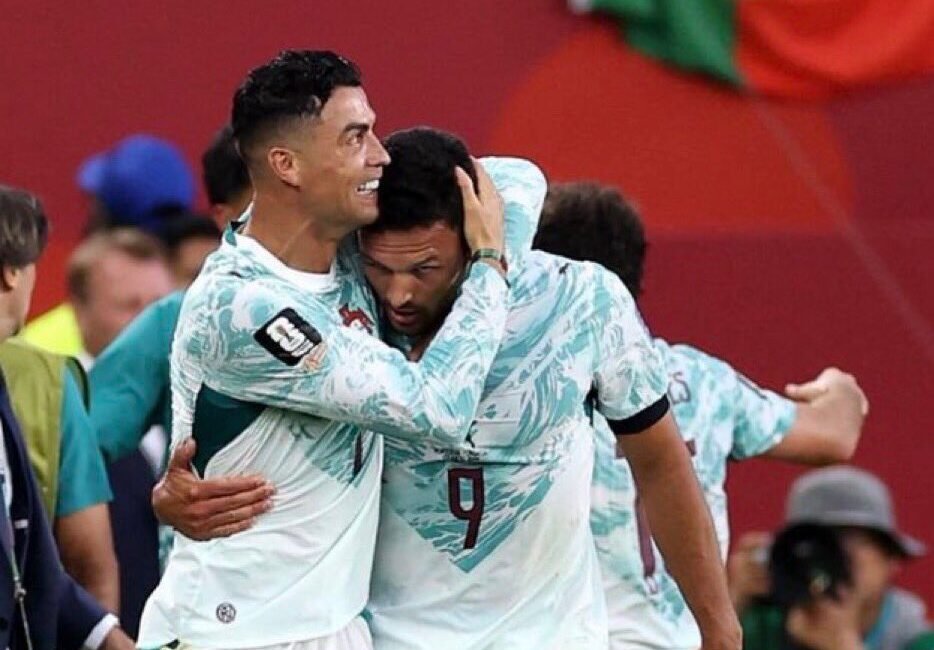
At the final whistle, Cristiano Ronaldo walked across the Toronto Stadium pitch and embraced Luka Modric — his former teammate, his old rival, the man who had just played what could prove to be his last World Cup match. They held on for a long time. No cameras needed to understand what was being said. Four Champions League titles won together at Real Madrid. Nearly a decade of shared dressing rooms. Two legends of the modern game, meeting for the last time on the biggest stage of all. One carrying on. One walking away. The difference between them, on Thursday evening, was a penalty and a chip in a football.
Toronto, Canada: This was always going to be about more than football. Portugal and Croatia — Ronaldo and Modric — in a World Cup knockout match that carried the weight of an era’s closing chapter. What nobody quite expected was that it would also be decided by Connected Ball Technology detecting the faintest touch of Igor Matanović’s boot in the 103rd minute, ruling out what Croatia and most of the watching world believed to be an equaliser, and sending the 2018 World Cup runners-up home in the most agonising fashion imaginable. Portugal advance to the Round of 16 with a 2-1 win. Croatia are out. And somewhere in the Toronto night, Luka Modric declined to discuss his international future and said nothing at all.
Read More: Oyarzabal double hands Spain first knockout win since 2010
Perisic Stuns Portugal, Then Ronaldo’s History Is Made
The match began at sapping evening heat with Portugal — first-half dominators — failing to convert their superiority into goals. Rafael Leão, Bernardo Silva and Bruno Fernandes all threatened without finding the finish that the occasion demanded, and Croatia — disciplined, hard-running and marshalled magnificently by their captain — absorbed everything Portugal threw at them. Then, in the 53rd minute, the tie turned on a Croatian counter-attack. Ivan Perisic — 37 years old, making his 120th international appearance, and still one of the finest left-sided players in European football — slotted the ball beneath the advancing Diogo Costa off a cross from Josip Šanišić. Croatia led. The Toronto night suddenly belonged to the underdogs.
Portugal’s response was immediate and chaotic in equal measure. Within minutes, Ronaldo had the ball in the net — controlling a long pass, spinning past his marker and finishing with the clinical confidence of a player who has scored 940 career goals. For a moment, Toronto held its breath. Then the assistant referee’s flag went up. VAR confirmed it: offside by a shoulder, the finest of margins. At 41 years old, Ronaldo had been denied what should have been his first-ever World Cup knockout stage goal by a distance measured in centimetres. “After my goal, offside, people start to believe,” he said afterward, with the pragmatism of a man who has long since made peace with the absurdities of the game.
ALSO READ: Kane, Tielemans win it late for England, Belgium
The Penalty. The Milestone. The “SIU.”
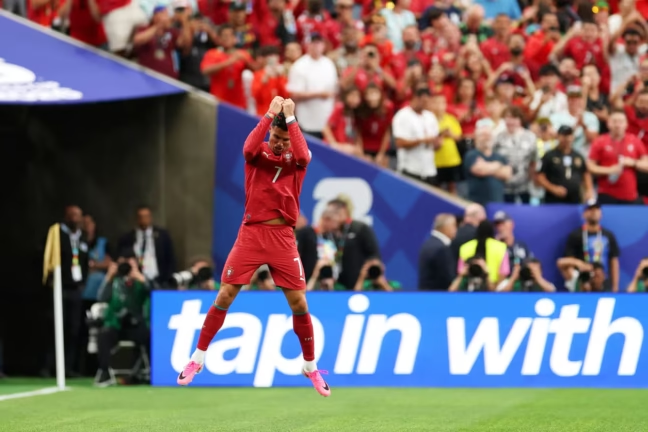
Justice, of a sort, arrived in the 67th minute. Renato Veiga surged into the Croatian penalty area and was grabbed by Nikola Vlasic — a foul clear enough that the VAR check was brief, the decision swift. Referee Espen Eskas pointed to the spot. In the history of Cristiano Ronaldo’s World Cup career — spanning five tournaments, 22 matches and more goals than any European player in the competition’s history — he had never scored in a knockout stage. That record ended when he sent Croatian goalkeeper Dominik Livaković the wrong way, driving the ball straight down the middle with a stutter-step run-up that stopped Livaković mid-dive. Ronaldo sprinted to the corner flag, arms outstretched, performing his signature “SIU!” celebration as the Portuguese end of the stadium erupted. The crowd bellowed it back. History had been made.
Portugal then dominated without converting — Mateo Kovačić hitting a thunderous shot that Diogo Costa tipped onto the post, the game stretching and straining toward extra time. Then, four minutes into stoppage time, Rafael Leão — who had been the best player on the pitch for long stretches of the evening — launched a perfectly weighted pass to the back post. Gonçalo Ramos, introduced as a substitute, arrived at pace and headed the ball past Livaković to make it 2-1. Portugal were through. Or so it seemed.
The Goal That Never Was — And a Nation’s Heartbreak
What followed in the final minutes of a match that already had enough drama for a full tournament was pure theatre — and pure anguish for Croatia. In the 103rd minute of a match that had long since entered its final seconds, substitute Joško Gvardiol poked the ball home from close range. Wild celebrations erupted among the Croatian players, staff and supporters. Modric ran toward the corner flag. Perisic collapsed to his knees in relief. The equaliser, they believed, had come.
The VAR check lasted a lifetime. The question was not just offside, but whether a touch had been made. FIFA’s Connected Ball Technology — a chip embedded in the official match ball — detected contact by Igor Matanović in the build-up, placing Mario Pasalic, who eventually scored, in an offside position. The referee was sent to the pitchside monitor. He returned, raised his hand, and disallowed the goal. Croatian fans threw bottles onto the pitch. Kovačić, one of the most composed midfielders in world football, was in tears. Modric stood in the centre circle, stunned, as the final whistle followed moments later.
Croatia coach Zlatko Dalić was measured but clear in his frustration: “I don’t want to comment on it too much, but the refereeing was definitely very poor. Nothing went our way — not a single foul, not a single decision. Nothing was favourable for us. But that’s not the reason we lost. The refereeing was poor — I don’t really have the right to complain.”
Croatia’s players argued that Matanović had not touched the ball. FIFA’s official statement on the incident read that the Connected Ball Technology data confirmed contact had been made. It is, as it has always been with VAR, a decision that will be debated for years.
A Hug, a Jersey, and a Final Goodbye
Two moments after the final whistle defined Thursday evening as something beyond a football match. The first was Ronaldo, standing in the Toronto night holding up the jersey of Diogo Jota — his Portugal teammate who died in a car accident a year ago — as the squad gathered for a photograph on the pitch. It was an act of remembrance that cut through every tactical analysis, every VAR debate, every stopwatch reading of the evening. Football, at its most human.
The second was the embrace between Ronaldo and Modric — 41 and 40, former Real Madrid teammates who won four Champions League titles together between 2012 and 2018, meeting for the last time in a World Cup. “I played with Luka so many years,” Ronaldo said afterward. “We’re nearly the same age. I think he’s a legend of football. He’s still a legend of football.” Modric, making his 202nd international appearance — his 23rd in the World Cup — declined to confirm his retirement. He didn’t need to. The look on his face at the final whistle said everything.
Modric leaves the World Cup stage having led Croatia to a final in 2018 and a bronze medal in 2022. He won the Golden Ball in 2018. He was Croatia’s player of the year 14 times. He won six Champions League titles at Real Madrid and the 2018 Ballon d’Or. He played 23 World Cup matches across five tournaments. The World Cup owes Modric a championship, as many have written. It never came. He can hold his head high with everything else.
Spain Await in Dallas
Portugal’s reward for surviving one of the tournament’s most dramatic nights is a Round of 16 clash against Spain — who dismantled Austria 3-0 in their Round of 32 match to advance with impressive authority — at Dallas Stadium on July 6. The Iberian derby. Ronaldo versus Lamine Yamal, Pedri, and Unai Simón. A rivalry that traces back to the Napoleonic Wars and has been renewed at major tournaments since. Portugal, riding the emotion of Thursday’s survival, will arrive in Dallas as underdogs — and by now, perhaps, entirely comfortable with that label.
Result — 2026 FIFA World Cup | Round of 32
Portugal beat Croatia 2:1
Goals: Ivan Perisic 53′ (CRO) | Cristiano Ronaldo pen. 68′ (POR) | Gonçalo Ramos 90’+4 (POR)
Disallowed: Ronaldo ~60′ (offside by a shoulder) | Joško Gvardiol 90’+13 (offside — Matanović touch, Connected Ball Technology)
Next: Portugal vs Spain — Dallas Stadium, July 6, 2026