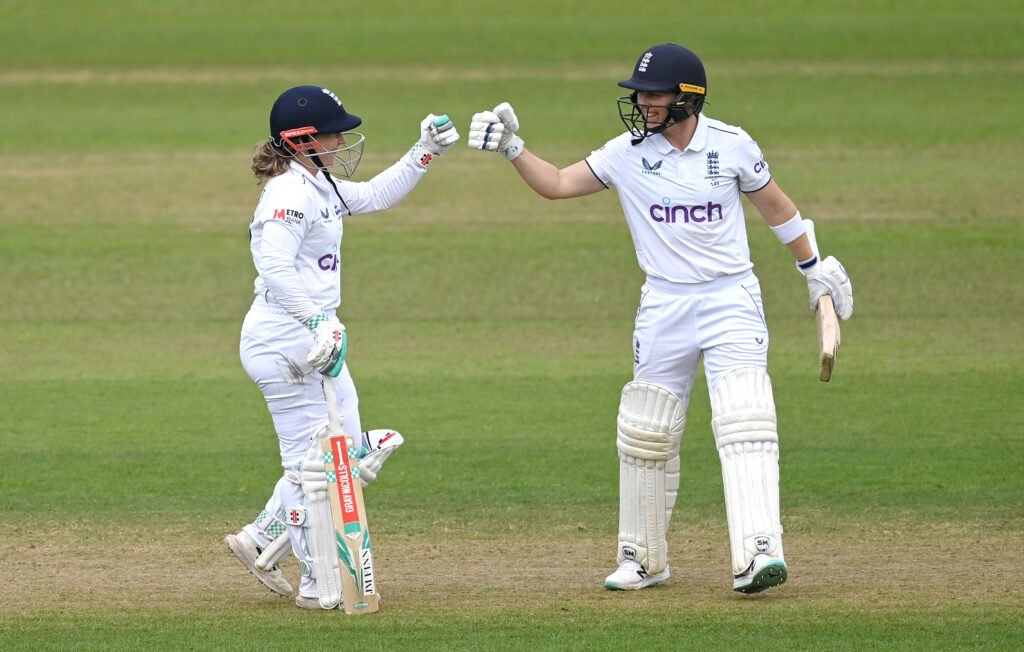
England captain Heather Knight and opening batter Tammy Beaumont have announced their retirements from international cricket during the one-off Test against India at Lord’s, a match in which England were set a world record chase of 457 and slumped to 130-6 by the close of day three. Knight’s retirement, confirmed by the England and Wales Cricket Board on Saturday, closes the book on her 320-appearance England career, the most of any player in the team’s history, and comes as she calls for more red-ball cricket to be scheduled ahead of next year’s multi-format Ashes series against Australia, in which Test victories will carry four points.
There are retirements that arrive as formalities, tidying up a career already winding down, and there are retirements that land as genuine punctuation marks in a sport’s history. Heather Knight’s belongs unmistakably to the latter category. She leaves having carried England’s women through the era in which the professional game found its shape, and she chose to do so not in a quiet farewell but in the middle of a Test match that was, in its own bruising way, a reminder of how much work remains.
The symmetry will not be lost on anyone who has followed her career. Knight’s finest hour as captain came at Lord’s in 2017, lifting the World Cup on the ground where, nine years later, she walked away from the international game entirely.
A career closed at the scene of its greatest triumph
Knight’s international story began in 2010 and ends with 320 appearances, an England women’s record that stood as testament to her durability as much as her ability. She captained the side in 199 matches between 2016 and 2025, winning 134 of them, a tenure that spanned England’s transition from a part-time set-up to a fully professional one.
Her leadership ended after last year’s chastening Ashes tour, when England were beaten 16-0 in Australia, a defeat comprehensive enough to end her captaincy. That Knight chose the India Test at Lord’s, rather than a quieter fixture, to step away entirely says something about her regard for the occasion and the ground.
Her final match with bat in hand brought only 13 runs, as England’s top order buckled. It was not the ending a captain of her stature might have scripted, but it was arguably fitting that she departed mid-battle rather than in comfort.
Beaumont’s exit and a chastening scoreline
Tammy Beaumont’s retirement, announced at the same moment, added further weight to a Test that had already taken on the feel of a changing of the guard. Beaumont’s final innings brought a golden duck, an unforgiving way to bow out but not one that will diminish a career spent opening England’s innings through some of its most turbulent periods.
The cricket itself was harsh reading for England. India’s first innings total of 285, built on Smriti Mandhana’s 83 and restrained by Sophie Ecclestone’s 3-68, was always going to be competitive. England’s reply of 170, in which Amy Jones’s 52 was the standout contribution against Gaud’s 5-37, left them exposed to the kind of declaration India duly delivered.
Yastika Bhatia’s century, 113, powered India’s second innings to 341-7 before the declaration, with Ecclestone again the most persistent English threat. The consequence was a fourth-innings target of 457, a world record chase by any team in women’s Test history, set purely to make England bat out time rather than genuinely entertain victory.
Nat Sciver-Brunt, now captain following Knight’s departure from the leadership last year, fell for 11, bowled attempting a sweep. England’s innings then disintegrated to 59-5 before Mady Villiers and Jones added 67 for the sixth wicket, the only period of the chase in which England looked settled. By the close of day three, England stood on 130-6, still needing 327 runs with Jones unbeaten on 52 and Satghare among the wickets on 2-19.
Why Knight’s call for more Test cricket matters now
It is against this backdrop that Knight’s appeal for England to play more red-ball cricket carries its sharpest relevance. The women’s game has historically offered Test matches sparingly, a scheduling reality that leaves players with little opportunity to develop the patience and technical solidity that fifty-over and T20 cricket do not demand in the same way. A one-off Test, however meaningful the occasion, cannot substitute for a genuine red-ball culture.
The timing sharpens the stakes considerably. Next year’s multi-format Ashes series against Australia at home will award four points for a Test win, more than either white-ball format, making red-ball performance disproportionately decisive in deciding the destiny of the urn. Given England’s 16-0 whitewash in Australia last year and the manner of this defeat by India, the argument that England need more first-class exposure before facing Australia again is difficult to dismiss.
Knight leaves that particular fight to others now, but her final months in the England set-up were not without distinction elsewhere. In the recent ICC Women’s T20 campaign, she made 58 runs off 47 deliveries in the semi-final against South Africa, an innings that helped steer England into the final and offered a reminder, if one were needed, of the competitive instincts that defined her career.
What comes next for England
England’s immediate task is to see out the remainder of this Test against India, a rearguard action that Jones and whoever partners her will need to extend deep into the final day. Beyond that, the more pressing questions belong to Sciver-Brunt and the ECB: how England rebuild their red-ball depth, and how quickly, before the four-point stakes of next year’s home Ashes series arrive. Knight’s warning, delivered in the same breath as her farewell, may prove to be her most consequential contribution yet.