|
Getting your Trinity Audio player ready...
|
India’s Commonwealth Games 2026 campaign has been hit by a doping double blow before it has properly begun — judoka Arun Kumar has been withdrawn from the Glasgow Games after testing positive for an anabolic steroid in an out-of-competition NADA test, while weightlifter Dilbagh Singh has been sent home as collateral damage of five doping violations within Indian weightlifting that cost the sport five qualification slots.
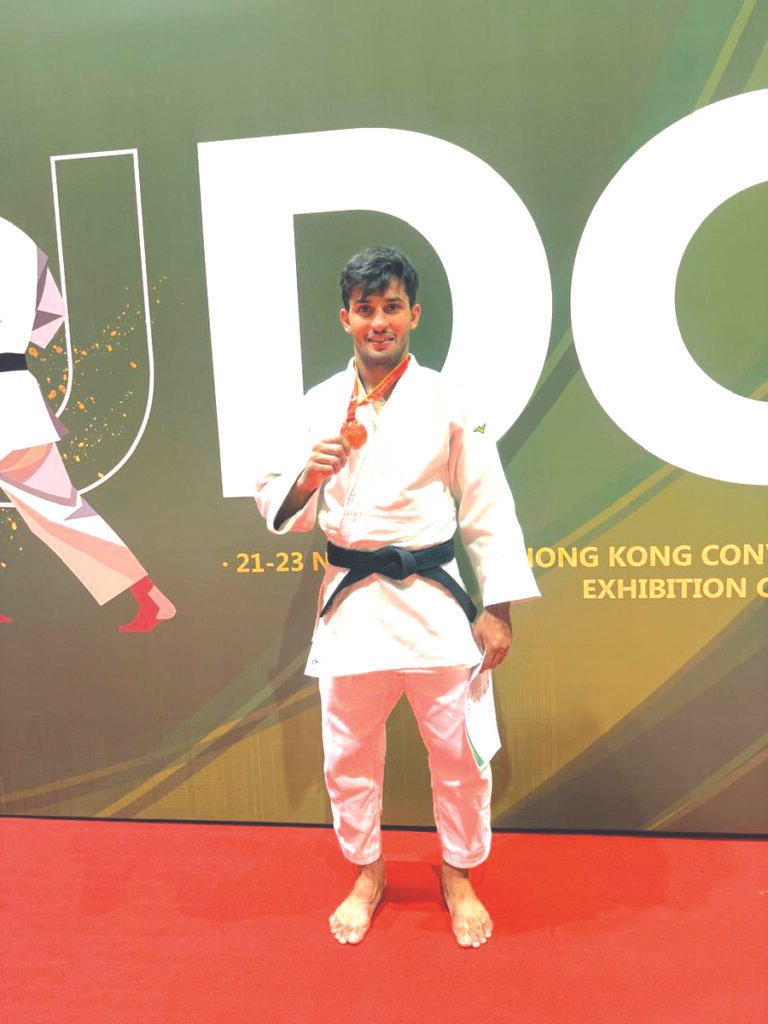
Glasgow / New Delhi: The flags were still being folded after Thursday’s Opening Ceremony at the OVO Hydro when the news broke. Indian judoka Arun Kumar, who competes in the men’s 73kg weight category, has been placed under provisional suspension by the National Anti-Doping Agency (NADA) after testing positive for a prohibited anabolic steroid during routine anti-doping testing conducted outside competition. The setback drops India’s overall athlete contingent size down to 124 competitors.
“The notification for suspension has come. We have to withdraw him,” a well-placed source in the Indian judo federation told PTI. The language was clinical. The impact was blunt. Arun had most recently competed at the Qingdao Grand Prix last month, where he represented India in the highly competitive 73kg division. That tournament now forms part of the backdrop to a case that has ended his Glasgow dream before it began.
No Replacement, No Recourse
The Indian judo team is yet to depart for Glasgow as the sport’s competition schedule unfolds from July 31. The team is due to leave on July 27. The timing adds a layer of cruelty — Arun’s teammates will travel to Glasgow knowing one of their own has been left behind. India cannot name a replacement due to the competition’s guidelines, meaning the 73kg slot simply disappears from India’s judo programme.
The substance detected in Arun’s sample has been identified as an anabolic steroid — a class of performance-enhancing drugs prohibited under the WADA Prohibited List. Anabolic steroids are banned because they can enhance muscle growth, increase strength, improve recovery time and provide athletes with an unfair competitive advantage. The positive test emerged from an out-of-competition sample, the kind collected as part of NADA’s regular programme designed to ensure athletes remain compliant year-round, not merely during tournaments.
Read More: Putul Sonowal stuns world champion Ryan Bester at Commonwealth Games 2026 Bowls
Dilbagh Singh: Innocent Bystander of a Sport’s Crisis
The second withdrawal is more complex — and in some ways more troubling for what it says about India’s weightlifting ecosystem.
Dilbagh Singh was named in India’s 12-athlete weightlifting squad but has been called back from Glasgow. His offence? None — at least not personally. India’s weightlifting had five cases of doping between June 1, 2025, and July 22, 2026, and as a result the quota for India at the Commonwealth Games was reduced from 16 to 11 for the weightlifting squad.
The governing rules are unambiguous. Clause 2.4 of the qualification system states that during the period of June 1, 2025, to July 22, 2026, the maximum number of athlete qualification slots allocated to a CGA will be reduced by one if any weightlifting athlete commits an anti-doping rule violation. Five violations meant five slots gone — and Dilbagh Singh, who had qualified legitimately, was the one left without a chair when the music stopped.
It is a brutal but logical consequence of the sport’s collective failure. India’s weightlifting doping record at Commonwealth Games editions has been a recurring source of embarrassment, and the qualification quota penalty is the CGF’s mechanism for holding federations accountable when individual sanctions prove insufficient. Dilbagh Singh is paying the price of that system — and of his sport’s inability to keep its athletes clean.
ALSO READ: CWG 2026: Lovlina Borgohain secures India’s first medal without stepping in the ring
A Recurring Problem India Must Address
The withdrawals cast a familiar shadow. India has faced doping embarrassments at Commonwealth Games editions before — Birmingham 2022, Gold Coast 2018, Glasgow 2014 all had their moments — and each time the conversation returns to the same place: a system that catches athletes after the damage is done rather than educating them before it begins.
Dr. Passey, speaking on the issue, acknowledged India having “a huge number of athletes working on different levels who gradually progress to national levels” but noted that “there are many loopholes where athletes are not aware of what actually is doping and what actually is not doping — what substances are usually included in the prohibited list and what substances are not.” It is a frank admission of a systemic education failure that goes well beyond Arun Kumar or Indian weightlifting.
For the 124 athletes who remain in Glasgow — the bowlers winning thrillers, the para powerlifters chasing medals tonight, the gymnasts competing in the team final at 10 PM IST — the show goes on. But the two empty seats on the plane to Glasgow are a reminder that India’s clean sport challenge is far from solved.
Summary of withdrawals:
Arun Kumar (Judo, 73kg) — Provisionally suspended by NADA for testing positive for an anabolic steroid in an out-of-competition test. Cannot be replaced per CWG rules. Judo team departs July 27; competition begins July 31.
Dilbagh Singh (Weightlifting) — Withdrawn due to India’s weightlifting quota being reduced from 16 to 11 following five Indian weightlifting doping violations between June 1, 2025, and July 22, 2026. No personal violation.