|
Getting your Trinity Audio player ready...
|
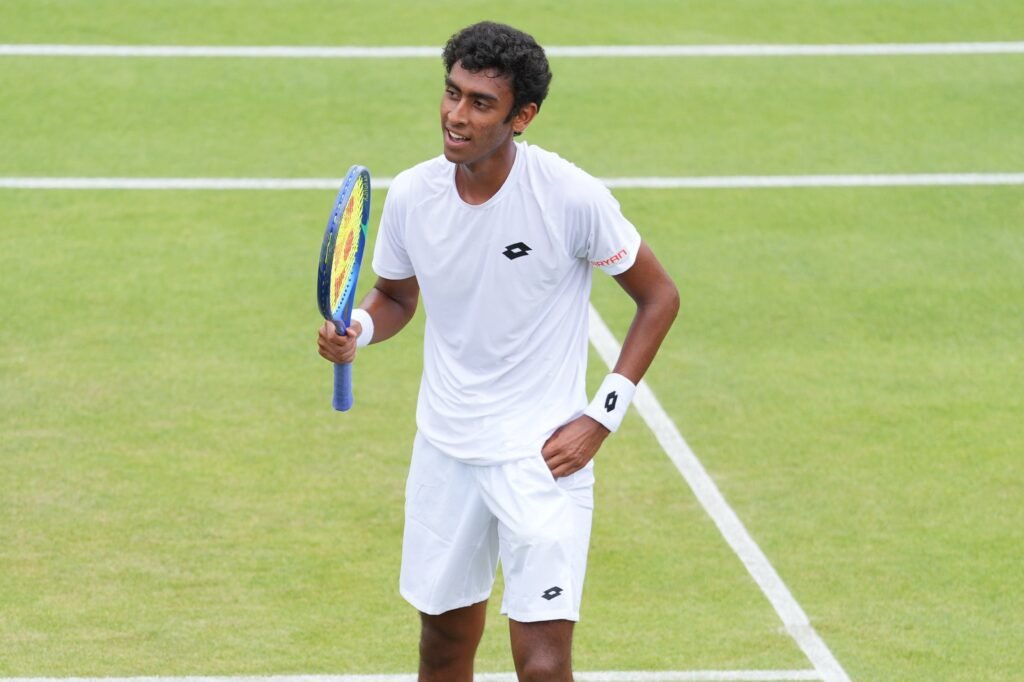
Eighteen-year-old Arnav Paparkar’s remarkable Wimbledon journey came to an end in the boys’ singles quarter-finals on Thursday, as the unseeded Indian fell 2-6, 5-7 to American Jordan Lee in straight sets at the All England Club. The defeat ended a breakthrough fortnight, but not before Paparkar became the first Indian in 36 years to reach the last eight of the Wimbledon boys’ singles event, matching a milestone last achieved by Leander Paes during his title-winning campaign in 1990. Arriving at the Championships ranked World No. 19 among juniors and making his Wimbledon debut, Paparkar departed having announced himself as one of India’s brightest young tennis prospects.
London, Great Britain: Every breakthrough ends eventually. Some conclude with a trophy, some with a handshake across the net and the quiet determination. That’s what happened with Arnav Paparkar, who left the All England Club on Thursday without a place in the semi-finals, but with something almost as valuable for a teenager beginning his journey — belief, recognition and a place in Indian tennis history.
For 36 years, no Indian boy had progressed beyond the fourth round at Wimbledon. Generations of talented juniors arrived in London carrying hope, only to leave before the business end of the tournament. Paparkar changed that. Over four matches on the lawns of SW19, he displayed a game built for grass courts: a powerful first serve, fearless attacking instincts and a composure that rarely betrayed the fact he was making his first appearance at the Championships.
His campaign ultimately ended against American Jordan Lee, who produced the steadier tennis on the day to book a place in the semi-finals. Paparkar fought throughout but was unable to reproduce the dominant form that had carried him through the opening three rounds. The disappointment was immediate, yet it did little to diminish what had already become one of the finest Wimbledon performances by an Indian junior in more than three decades.
Three Victories That Changed the Conversation
Paparkar’s Wimbledon began with a confident 6-2, 6-2 victory over Britain’s Joshua Craze. It was an opening-round performance that immediately suggested he was more than comfortable on grass. His serve earned free points, his groundstrokes stayed compact under pressure and he dictated rallies with the confidence of a player unfazed by the occasion.
The second round was where his tournament truly came alive.
Across the net stood Keaton Hance, the third seed, Junior World No. 3 and one of the favourites for the title. Paparkar responded with one of the biggest upsets of the boys’ draw, winning 6-2, 6-3 without facing a single break point. Six aces, relentless pressure on return and a clear tactical plan transformed what many expected to be a difficult afternoon into one of the standout performances of the tournament.
If the victory over Hance earned attention, the third round confirmed it was no fluke.
ALSO READ: Wimbledon 2026 quarterfinals: Gauff fights back, Muchova ends Osaka’s dream
Against Japan’s Ryo Tabata, Paparkar produced arguably his cleanest display of the fortnight. Eight aces, no double faults and a dominant 6-2, 6-1 victory in just 52 minutes sent him into the quarter-finals without dropping a set. By then, he had become the first Indian boy since Leander Paes in 1990 to reach the last eight at Wimbledon.
A Quarter-final Too Far
Every Grand Slam has a day when momentum meets resistance. For Paparkar, that day arrived in the quarter-finals.
Jordan Lee absorbed the Indian’s early aggression and gradually imposed himself from the baseline, forcing longer rallies and denying Paparkar the quick points that had proved so decisive throughout the opening week. Whenever opportunities emerged, the American capitalised, while Paparkar struggled to generate the same consistency on serve that had underpinned his earlier victories.
The straight-sets defeat ended the run, but it also provided an important reminder of the fine margins that separate the world’s best junior players. At this level, a handful of missed chances can quickly become the difference between a semi-final appearance and the journey home.
The Shadow of Leander Paes
For Indian tennis, the significance of Paparkar’s campaign extends well beyond one quarter-final.
The last Indian boy to reach this stage at Wimbledon was Leander Paes in 1990. That summer, Paes went on to lift the boys’ singles title before building one of the greatest careers in Indian tennis history.
Reflecting on that triumph years later, Paes described the Wimbledon title as the moment that convinced him he belonged in professional tennis.
“Winning the junior Wimbledon in 1990 was one of the most wonderful memories,” Paes once said. “Even winning the doubles and the mixed doubles in 1999 does not match winning the boys’ singles because that gave me the mental belief that I could be a tennis player.”
Paparkar has not matched that achievement — not yet. But becoming the first Indian in 36 years to return to the quarter-finals is, in itself, a milestone that reconnects Indian tennis with a part of its own history that had long felt distant.
A Foundation Rather Than a Finish
Paparkar arrived in London as Junior World No. 19, carrying encouraging results from the ITF junior circuit and a third-round appearance at Roland Garros earlier this season. He leaves having demonstrated that those performances were no coincidence.
Grass rewards first-strike tennis, confident serving and decisive movement forward. Throughout the fortnight, Paparkar displayed all three. More importantly, he showed an ability to embrace pressure rather than retreat from it, defeating higher-ranked opponents and handling the expectations that inevitably followed each victory.
READ MORE: Wimbledon 2026 quarterfinals: Sinner, Djokovic, Zverev and fairy-tale Fery
The quarter-final defeat will hurt. It should. Every ambitious athlete remembers the tournaments that slipped away.
But viewed across the entire fortnight rather than a single afternoon, Wimbledon 2026 represents something far more significant than one loss. It marks the arrival of another Indian junior capable of competing deep into Grand Slam events, and perhaps the beginning of a journey that extends well beyond the junior circuit.
History will record that Arnav Paparkar’s Wimbledon ended in the quarter-finals.
Indian tennis may remember it as the tournament where a new chapter quietly began.
Arnav Paparkar — Wimbledon 2026 Boys’ Singles
Round 1: def. Joshua Craze (GBR) — 6-2, 6-2
Round 2: def. Keaton Hance (USA, 3rd seed) — 6-2, 6-3
Round 3: def. Ryo Tabata (JPN) — 6-2, 6-1
Quarter-final: lost to Jordan Lee (USA) — 2-6, 5-7
Tournament Highlight: First Indian boy to reach the Wimbledon boys’ singles quarter-finals since Leander Paes in 1990.