
|
Getting your Trinity Audio player ready...
|
Cristiano Ronaldo scored twice and became the first player in history to score in six different FIFA World Cups as Portugal brushed aside Uzbekistan 5-0 in Houston. Roberto Martínez’s side bounced back emphatically from their frustrating opening draw against DR Congo to revive their Group K campaign and reassert their credentials as genuine contenders.
Houston, Texas: The doubts had grown louder over the past week. The criticism, for perhaps the first time in Cristiano Ronaldo’s extraordinary career, had begun to feel unavoidable.
After Portugal’s underwhelming 1-1 draw against DR Congo in their World Cup opener, questions swirled around the 41-year-old captain. Had age finally caught up with him? Was this, his sixth and likely final World Cup, becoming one tournament too many?
On Tuesday night at NRG Stadium, Ronaldo delivered his answer in emphatic fashion.
Leading from the front, the Portugal captain inspired a commanding 5-0 victory over World Cup debutants Uzbekistan and, in the process, etched his name even deeper into football history.
For a team searching for momentum after a disappointing start, and for a player whose place in the starting XI had suddenly become a talking point, the response could hardly have been more emphatic.
Ronaldo and Portugal needed just six minutes to seize control.
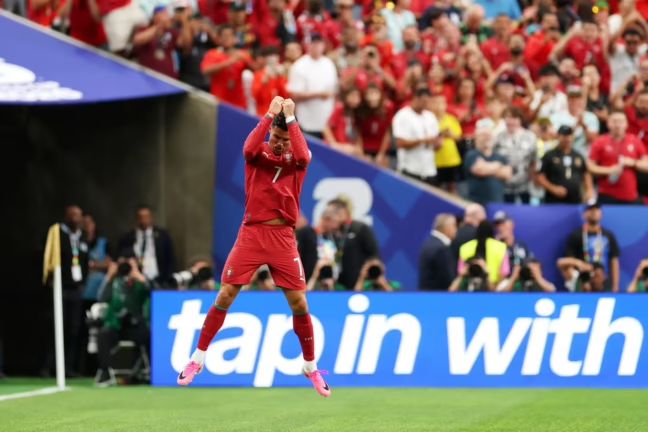
João Cancelo surged down the right flank before delivering a low cross into the penalty area. Ronaldo, anticipating the move before anyone else, timed his run perfectly and swept home from close range.
The finish itself was routine. The significance was anything but.
Germany 2006. South Africa 2010. Brazil 2014. Russia 2018. Qatar 2022. USA 2026.
No player in history had scored at six separate World Cups. Until now.
Ronaldo sprinted towards the cameras and let out a huge cry: “I’m back.” Some might argue it was more a sigh of relief than a celebration, but either way, the strike seemed to lift not just the captain but the entire Portuguese side.
The goal immediately settled Portugal, who looked transformed from the disjointed team that struggled against DR Congo. Bruno Fernandes and Vitinha dictated possession from midfield, while João Félix and João Cancelo repeatedly found space in wide areas.
Uzbekistan, making their first appearance at a World Cup finals, attempted to remain adventurous but struggled to cope with Portugal’s movement and relentless pressing.
Ronaldo Plays Decoy
Portugal doubled their advantage in the 17th minute through an inventive set-piece routine.
Lining up over a free-kick just outside the penalty area, Ronaldo appeared certain to shoot, prompting both the defensive wall and goalkeeper Utkir Nematov to prepare accordingly. Instead, the captain cleverly stepped aside, allowing Nuno Mendes to curl a superb effort into the far corner.
The decoy worked perfectly and underlined a broader truth about Ronaldo’s performance. This was not merely a night of goals; it was a captain leading, adapting and influencing the game in multiple ways.
However, managed by former Italy captain Fabio Cannavaro, the World Cup debutants continued to search for openings and briefly thought they had found one when Azizjon Ganiev unleashed a stunning long-range strike shortly after the restart.
The celebrations, however, proved short-lived.
Following a VAR review, the goal was ruled out for a foul in the build-up, extinguishing any realistic hopes of an unlikely comeback.
Historic Goal for Ronaldo
By the time Ronaldo struck again in the 39th minute, the contest already felt beyond Uzbekistan.
Fernandes threaded a perfectly weighted pass behind the defence, and Ronaldo, showing the movement and composure that have defined his career, calmly slotted past Nematov for his second goal of the evening and his tenth overall at the World Cup. The strike moved him beyond the legendary Eusébio as Portugal’s leading scorer in World Cup history.
Portugal went into the break with a commanding 3-0 lead.
Beyond the scoreline, there were also clear signs that Martínez’s side had rediscovered their identity. Portugal moved the ball through central areas with far greater patience than they had shown in their opener, frequently drawing Uzbekistan forward before exploiting the spaces left behind. The fluidity and control that had been missing against DR Congo were back in abundance.
An hour into the match, chaos inside the six-yard area from a Fernandes corner resulted in Nematov inadvertently turning the ball into his own net under pressure from Rúben Dias.
With the scoreline already beyond doubt, much of the attention inside NRG Stadium turned towards whether Ronaldo could complete a memorable hat-trick. The veteran forward came close on several occasions, only to be denied by Nematov, who at least managed to salvage some personal pride despite the scoreline.
The final flourish arrived three minutes from time.
Substitute Rafael Leão, introduced midway through the second half, raced onto a loose ball on the edge of the area and lashed an unstoppable strike into the top corner to complete the rout and cap a dominant Portuguese performance.
For Martínez, the result represented far more than three points.
After a nervy start to the tournament, Portugal suddenly look like themselves again. The attacking fluency has returned, the midfield appears settled and, perhaps most importantly, Ronaldo has rediscovered his scoring touch.
A far sterner challenge awaits against Colombia in their final group match, but Portugal will travel into that fixture with renewed confidence and momentum.
Much of that confidence stems from the resurgence of their captain.
The debate over Ronaldo’s place in this side is unlikely to disappear entirely. Great players rarely escape scrutiny, particularly at the age of 41.
But for one night in Houston, none of that mattered.
Twenty years after scoring his first World Cup goal, Cristiano Ronaldo once again stood at the centre of football’s biggest stage and reminded the world that writing him off remains a dangerous game.
Score: Portugal 5: Uzbekistan 0 (Ronaldo 6′, 39′; Nuno Mendes 17′; Nematov (own goal) 60′; Rafael Leão 87′)
Player of the Match: Cristiano Ronaldo (Portugal)
Pingback: Neymar returns as Vinicius' brace sends Brazil into knockouts
Pingback: Hamilton's Ferrari resurgence faces stern Austrian test