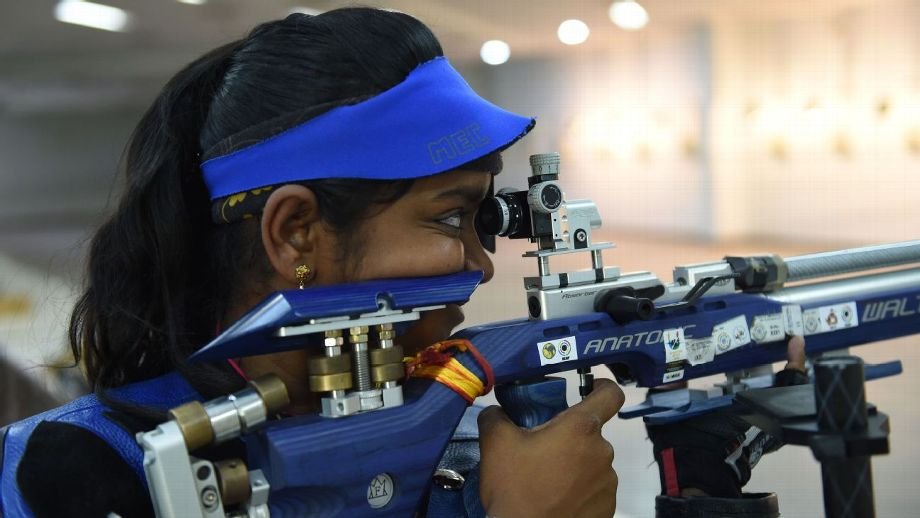
India’s women’s 10m air rifle team of Elavenil Valarivan, Sonam Mhaskar and Vidarsa Vinod won silver at the 2026 Asian Games in Aichi-Nagoya, Japan, scoring 1898.0 points to secure the country’s first medal of the tournament. China claimed gold with a world-record 1904.2, while hosts Japan took bronze on 1897.1.
There is a particular symmetry to how India’s shooters chose to open their account in Aichi-Nagoya. Three years after a silver in the same event at Hangzhou, the trio of Elavenil Valarivan, Sonam Mhaskar and Vidarsa Vinod returned to the podium in near-identical fashion — not as a coincidence, but as confirmation that India’s depth in this discipline has become something closer to a system than a streak of individual brilliance.
That the medal arrived on the very first day India needed a result to build around only sharpens its significance. In a Games where momentum can be shaped as much by early psychology as by raw scoring, this was the platform the rest of the campaign now stands on.
A total that would have won gold almost anywhere else
India’s combined score of 1898.0 was, by any recent historical measure, an excellent result. It simply ran into a Chinese team performing at a level beyond precedent. China’s 1904.2 was not merely a winning score; it was a world record, redefining what a team total in this event now looks like at the elite end.
Japan’s bronze-winning 1897.1, achieved on home soil, underlines how tight the margins were. Barely a point separated India from the hosts, and the gap to gold, though decisive on the scoreboard, reflected China’s exceptional consistency rather than any lapse from the Indian trio.
Mhaskar’s rise and a team built on balance
Central to India’s total was Sonam Mhaskar, reported as the team’s top scorer on the day. Her contribution offset the pressure on Valarivan, already one of India’s most recognisable shooters, and gave the team a second reliable point of strength alongside her — with Vidarsa Vinod completing a unit.
This balance is precisely what separates a one-off medal from a repeatable one. India did not lean on a single standout performance; they assembled a total through contribution across all three shooters, which is the pattern that produced Hangzhou’s silver and has now produced its successor.
A defining day for Valarivan
The team event was only part of Valarivan’s afternoon. She and Mhaskar had already qualified for individual finals held later the same day, and Valarivan went on to add an individual silver in the women’s 10m air rifle final, finishing on 252.4 — behind Japan’s Hinata Taichi, whose 253.0 set a Games Record. Taken together, it made for one of the standout individual programmes, even before accounting for the team result.
The double medal haul, across two distinct events, reflects the kind of sustained focus that major Games demand. Backing up a team event with an individual podium on the same day is a considerable physical and mental undertaking, and Valarivan’s ability to do both speaks to the depth of preparation behind India’s shooting programme.
Recognition from home
The result did not go unnoticed in New Delhi. Union Sports Minister Mansukh Mandaviya publicly congratulated the team, hailing it as India’s first medal of the Games — an early marker of the significance placed on this result within India’s broader Asian Games ambitions.
What comes next
With the opening medal secured and two shooters already through to individual contention, India’s shooting contingent has set an early tone for the Games. The challenge now is consistency — replicating this level across the individual finals and the events still to come, as India looks to build a squad total that goes beyond the silver-medal ceiling it has now met at two consecutive editions.