
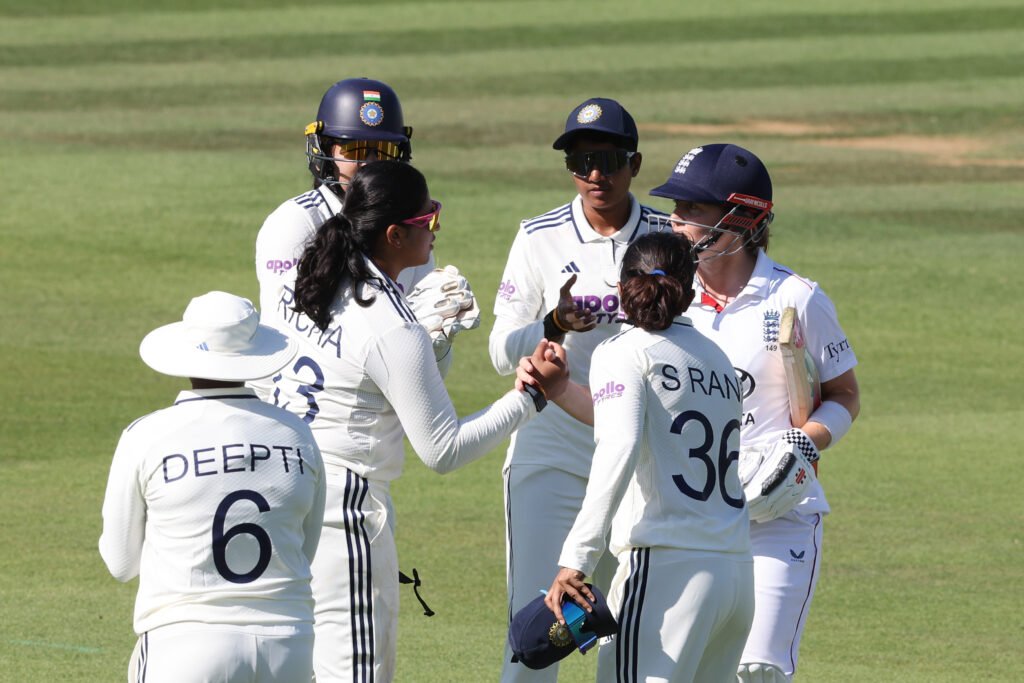
India completed one of the greatest victories in their women’s Test history on Sunday, defeating England by 270 runs in the historic first-ever women’s Test at Lord’s after dismissing the hosts for 186 on the fourth morning. Yastika Bhatia’s landmark 113 — the first century in a women’s Test at the Home of Cricket — and Kranti Gaud’s dream debut, which produced a five-wicket haul and a place on the Lord’s honours board, laid the platform before Sneh Rana wrapped up the innings with four wickets. India’s first innings of 285 (Smriti Mandhana 83, Harmanpreet Kaur 58, Deepti Sharma 57; Sophie Ecclestone 3-68) was answered by England’s 170 (Amy Jones 52; Kranti Gaud 5-37), before India’s second-innings declaration on 341-7 (Yastika Bhatia 113, Mandhana 70, Richa Ghosh 50; Ecclestone 5-118) left England chasing a world-record target of 457 that proved far beyond their reach.
There are Tests that will be remembered for scorecards, and there are Tests that will be remembered for the moment the ground itself changed. Lord’s had waited 142 years to host a women’s Test match, and by the time the final wicket fell on the fourth afternoon, it had delivered a champion in Yastika Bhatia, a wrecking ball in Kranti Gaud, and one of the finest overseas victories Indian women’s cricket has ever produced.
For Tammy Beaumont and Heather Knight, two of the most decorated names in the English game, this was supposed to be a stage for a farewell befitting their careers. Instead, their final Test became entwined with India’s relentless pursuit of history — a pursuit completed in emphatic fashion as Harmanpreet Kaur’s side walked away with a landmark victory at the Home of Cricket.
London, England: The scale of what India achieved here cannot be separated from the manner of it. This was not a rearguard success built on containment. It was a declaration of intent from the moment Harmanpreet Kaur’s side took first use of a placid Lord’s surface and made ruthless use of it.
Ecclestone’s Landmark, Buried by the Scoreboard
Day one belonged, statistically, to Sophie Ecclestone. Her 3-68 took her past Katherine Sciver-Brunt as England’s all-time leading wicket-taker across all formats, a mark that speaks to a career built on relentless control of the middle overs. It ought to have been the story of the day.
Instead, it was overshadowed within hours. Mandhana’s 83, supported by half-centuries from Harmanpreet and Deepti Sharma, carried India to 285 all out, and by the time England had stumbled to 21-1 in reply, the tone of the match had already been set. Nat Sciver-Brunt’s decision to bowl first had not accounted for the depth India now possess with the bat.
The Collapse That Defined the Contest
If day one established India’s dominance, day two confirmed England’s fragility. Collapses of 3-15 and 6-39 stretched India’s lead to 115, and by the time Kranti Gaud had finished with 5-37 in England’s first-innings reply of 170, the match had tilted decisively away from the hosts.
Gaud’s spell was the kind that announces a career rather than simply wins a session. Bowling with pace and precision at a ground that has seen every great English seamer of the men’s game, she dismantled England’s middle order with an economy that gave Sciver-Brunt’s side no route back into the contest. Her five-wicket haul also ensured she became the first woman ever to feature on the Lord’s bowling honours board.
Bhatia’s Piece of History
Day three belonged to Yastika Bhatia. Her 113 made her the first-ever centurion in a women’s Test at Lord’s — a record that will sit alongside her name for as long as the ground stands. Supported by Mandhana’s 70 and Richa Ghosh’s 50, Bhatia’s innings allowed Harmanpreet to declare on 341-7 and set England a target of 457, a number with no precedent in the women’s game.
ALSO READ: Buttler’s 131 helps England dethrone India from top of rankings after 1,605 days
Ecclestone, again, could not be faulted individually. Her 5-118 in the second innings made for match figures that underlined her standing as England’s premier spinner, even as the runs continued to flow at the other end. But the arithmetic was now brutal: no side had ever chased anything approaching 457 to win a women’s Test.
Beaumont and Knight: An Ending Written in Collapse
What followed was as poignant as it was painful. Tammy Beaumont, playing her final international match, was bowled for a golden duck — a cruel bookend to a first-innings dismissal for two. Heather Knight, similarly playing out her final act in an England shirt, made 13 before being dismissed, her exit met with warm applause but little celebration in the context of the match situation.
Sciver-Brunt herself fell for 11, bowled while attempting to sweep, as England slumped alarmingly to 59-5. That two of the finest careers in English women’s cricket should end amid a collapse of this severity added a layer of sadness to what was otherwise a landmark occasion for the sport.
Villiers and Jones: Defiance Without Reward
England resumed the fourth morning requiring survival rather than victory, but the task had already become overwhelming. Amy Jones and Mady Villiers briefly prolonged the contest with disciplined resistance, adding valuable runs before India steadily tightened their grip.
Jones, who had top-scored with 52 in the first innings, once again showed composure under pressure, while Villiers battled gamely despite the deteriorating situation around her. Their resistance delayed the inevitable rather than altered it.
Once the partnership was broken, India’s bowlers closed in quickly. Sneh Rana, whose control had steadily increased as the pitch wore, removed the lower order to finish with 4 for 42, while Kranti Gaud added another wicket to cap a remarkable debut. England were eventually bowled out for 186, handing India a commanding 270-run victory.
A Victory That Changes the Narrative
The scoreline alone ensures this match occupies a permanent place in Indian cricket history. Winning an overseas Test is rare enough; winning the first women’s Test ever staged at Lord’s by 270 runs elevates this triumph into another category altogether.
Yastika Bhatia became the first woman to score a Test century at the Home of Cricket, earning a place on the famous Lord’s honours board. Kranti Gaud then became the first woman to appear on the bowling honours board after her outstanding five-wicket haul, followed by Ecclestone, who joined her in the next innings.
For England, the match ended with mixed emotions. Ecclestone’s outstanding performances with the ball and Amy Jones’ twin half-centuries were overshadowed by a batting line-up unable to withstand sustained pressure. The farewells to Tammy Beaumont and Heather Knight, two of England’s modern greats, deserved a happier ending than a heavy defeat.
For India, however, Lord’s will forever represent something different. It is where a new generation announced itself on cricket’s most famous stage. Harmanpreet Kaur’s side did not simply win a Test match — they produced a performance of authority, composure and belief that may come to define this era of Indian women’s cricket. When the first women’s Test at Lord’s is remembered years from now, it will not be recalled merely because it was the first. It will be remembered because India made sure it became theirs.