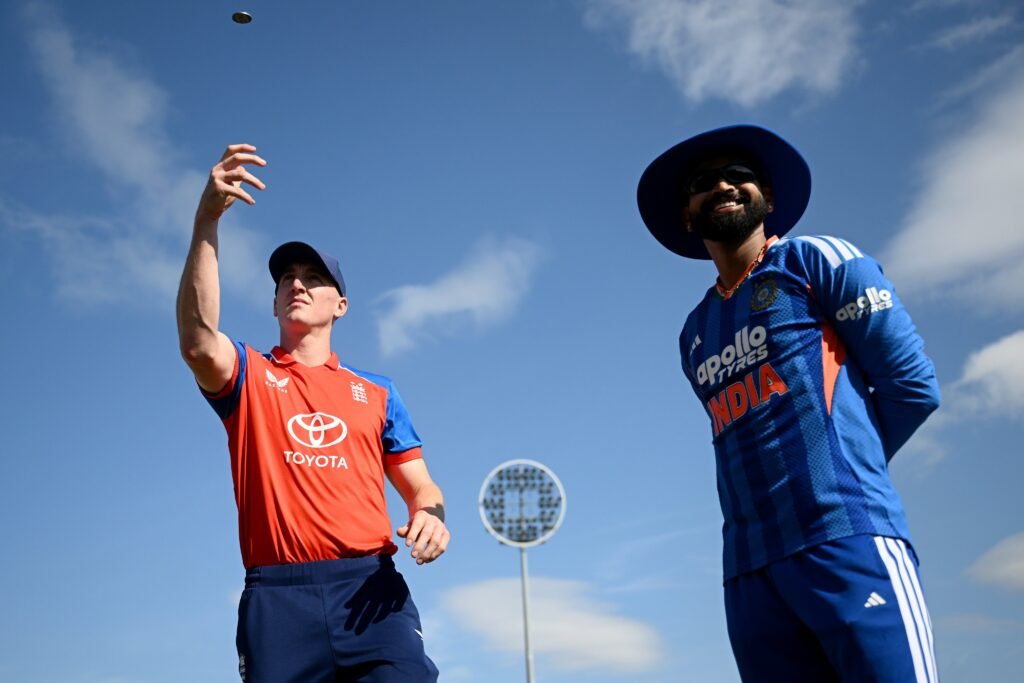
India captain Shreyas Iyer won his fifth consecutive T20I toss in Manchester on July 4, 2026, equalling a record held by MS Dhoni and Rohit Sharma, though his side remains winless in the post-World Cup cycle. In a must-win clash against England, India debuted Vaibhav Sooryavanshi—the nation’s youngest international player—as head coach Gautam Gambhir looks to reverse a run that has seen Iyer lose nine of his last 10 completed T20 matches as captain.
The coin falls in Shreyas Iyer’s favour with a regularity that borders on the supernatural, yet the silver lining ends at the feet of the match referee. To match the toss-winning streaks of MS Dhoni and Rohit Sharma is to enter a pantheon of Indian leadership defined by clinical execution and trophy-laden eras. For Iyer, however, the coin’s favourable flip has become a cruel irony—a recurring prologue to a story that, so far, lacks a winning conclusion.
Under the watchful, uncompromising eye of Gautam Gambhir, this Indian T20I side is a project in painful transition. They are a team caught between the record-breaking arrival of youth and the heavy burden of a winless streak that has persisted since the 2026 T20 World Cup. In Manchester, the stakes were no longer about experimentation; they were about survival.
Manchester, England: The statistics suggest a captain in total control of his environment, yet the reality on the turf tells a more fractured tale. By winning five consecutive T20I tosses, Iyer has achieved a statistical anomaly that usually signals a period of dominance.
Instead, India arrived at Manchester facing a must-win scenario against Harry Brook’s England. The “why” behind India’s recent slump is found in the disconnect between winning the start and finishing the job. Since the conclusion of the 2026 World Cup, India have navigated a landscape of defeats and a solitary washed-out match, leaving Iyer’s leadership under an intense microscope.
The Paradox of the Toss
Iyer’s individual struggle for results is not merely a modern international blip. Including his time in the IPL, the captain has now lost nine of his last 10 completed T20 matches as leader. It is a staggering run of form for a player entrusted with the post-Rohit Sharma era.
The decision-making at the top, however, remains resolute. With Ajit Agarkar’s tenure as chief selector recently extended, there is a clear mandate for continuity and long-term planning. The focus has shifted from immediate gratification to a total overhaul of the T20 philosophy, even if the scoreboard has yet to reflect the change.
The Dawn of Sooryavanshi
Amidst the tactical tension, history was made before a ball was bowled on July 4. In a poignant moment on the outfield, Tilak Varma presented a debut cap to Vaibhav Sooryavanshi. At that moment, Sooryavanshi became India’s youngest international cricketer, a selection that serves as a loud declaration of Gambhir’s intent.
The inclusion of a teenager in a high-pressure, must-win environment speaks to the “all-in” nature of the current coaching staff. This is a side no longer looking at the immediate past, but one desperately trying to manufacture a future.
The Gambhir Mandate
The shadow of Gautam Gambhir looms large over every tactical shift. That influence was visible in the aggressive, if currently unrewarded, brand of cricket India attempted to play in Manchester.
Gambhir and Agarkar have tethered their reputations to this transition. While Iyer provides the continuity in the middle, the tactical engine is being driven by a coach who demands high-risk, high-reward output. The lack of a victory since the World Cup has tested the patience of a demanding fanbase, but the internal belief in the Gambhir doctrine appears unshaken.
India now head into the remainder of the series knowing that records and milestones mean little without the currency of a win. For Shreyas Iyer, the luck of the toss must soon translate into the clinical edge that defined his predecessors, or the transition may become a permanent state of emergency.